

password hack apk · hacking panel · hacker typer · password cracker
Instagram password hack apk, hacking panel, hacker typer, password cracker: what these tools do to the person who installs them
None of them takes a password out of Instagram, because Instagram keeps no copy of it.
Reconstruction of a typical hack-app screen · not a real app
An apk can only show its own login screen and keep what you type. Hacker Typer is a joke site. A password cracker needs a stolen hash, and a username does not give it one. “Instagram hacking panel v3” is a name we could not find examined anywhere. Pick the one you found.
Tool by tool
Password hack apk, hacking panel, Hacker Typer, password cracker: what each one is
The names come from the searches that lead here. For each one: what it is, what has been documented, and where the documentation stops.
An apk shows its own login screen
“Instagram password hack apk”, “Instagram id hack apk”, “hacking apk”: an app on your phone cannot read passwords out of Instagram's servers. What apps of this kind have been caught doing is simpler.
- In 2022 Meta reported more than 400 Android and iOS apps — photo editors, games, VPNs, utilities — that asked people to “Login With Facebook” and stole the login and password typed in.
- Instagram's help on third-party apps: none of these services are affiliated with or endorsed by Instagram, and an app that gets your login or a token gets complete access to your account, private messages included.
- Modified Instagram apps (apk “mods”): a McAfee Labs article is cited as describing a mod that sends the typed login to a third party. The article did not open for us, so we know it only from search-result summaries and give no details.
- An apk taken from outside the store has not been through the store's check. Google says Play Protect runs a safety check on Play Store apps before you download them, and checks the device for potentially harmful apps from other sources.
The limit No source we read documents an apk that delivers someone else's password. Every documented case runs the other way: the installer's own login leaves the phone.
A “hacking panel” is a promise we found no published examination of
“Hacking panel v2”, “Instagram hacking panel v3”: the version number suggests software that keeps improving. We looked for a published teardown of such a panel by a platform or a security vendor and found none.
- What can be said without one: Instagram states that it never stores a copy of your password. Meta describes keeping a salted hash, and NIST requires the same of services.
- So a panel that asks for a username has nothing readable to fetch, whatever its version.
- For a neighbouring kind, the “generator”, a teardown exists. Malwarebytes took one apart in 2015: it showed running “hacker” lines and a success message, then demanded “verify” and led to surveys and offers collecting personal data. There was no generator behind it. That page was a game-code generator promoted through an Instagram page — it shows how the class is built, not what a particular panel does.
The limit We do not claim to know what a specific panel does with its visitor. We know only what it cannot do.
Hacker Typer is a joke site
“Hacker typer Instagram” is a search for hackertyper.net or one of its copies.
- Press any keys and movie-style code appears on the screen. The site says it grew out of wanting to look like the stereotypical hacker in movies and pop culture.
- Its author writes that he will not hack into anyone's personal property and asks people to skip such requests.
- It takes nothing from you and opens nothing. A video of someone “hacking Instagram” with code racing down a screen may be exactly this.
The limit This describes hackertyper.net. Copies under other names were not examined.
A password cracker guesses — and needs something to guess against
“Password cracker”, “Instagram password cracker”: cracking programs are real. They try candidate passwords until one matches a stolen hash. That happens away from the platform, on a breach someone already holds.
- A site that has only a username holds no hash. There is nothing for it to crack.
- Guessing at the login page itself runs into a limit: NIST requires services to restrict failed login attempts.
- Where guessing does work is on weak and reused passwords — which is why length and one password per account matter.
Act as if the password is known
Whether it was an apk, a panel or a “verify” page: if you typed a real login into it, treat that login as taken. The order of steps matters, and the first one is the password.
Six steps, in orderWhat it costs you
What a “password hack” tool takes from the person who uses it
Read by what you were asked to do. The right-hand column is who took such a thing apart.
| What you were told to do | What it takes | What you get | Who documented it |
|---|---|---|---|
| Log in “to connect your account” inside an app | Your own login and password. | Nothing. The account you typed is now open to someone else. | Meta, 2022 — more than 400 apps |
| Complete a “human verification” | Personal data entered into surveys and offers. | No password. There was no generator behind the page. | Malwarebytes Labs, 2015 |
| Log in on a page that copies Instagram | Username, password, sometimes the email password too. The page accepts anything typed. | A changed password, extortion, the same message sent to your contacts. Paying did not bring accounts back. | Trend Micro, 2021 |
| Paste a command, or install a “free” copy of a popular program | What an information stealer collects. The advisory lists credentials, crypto wallets, browser extension data and MFA data. | Malware on the device. | FBI and CISA, 2025 — advisory on LummaC2 |
| Pay a “specialist” for a key, access or activation | An advance, then more for “server access”, “verification”, “software”, “final activation”. | A fake login page, or a request to forward the code sent to you. | Bitdefender, 2026 |
These sources describe neighbouring cases, and we keep them apart. The Meta report is about Facebook logins. The Malwarebytes page was a code generator. The LummaC2 advisory is addressed to organisations and covers one stealer, not “hack” tools as a class. None of them tested something named “Instagram password hack”. What they share is the direction: something leaves the user, and nothing arrives.
Password cracker
Password cracker: what is real about it
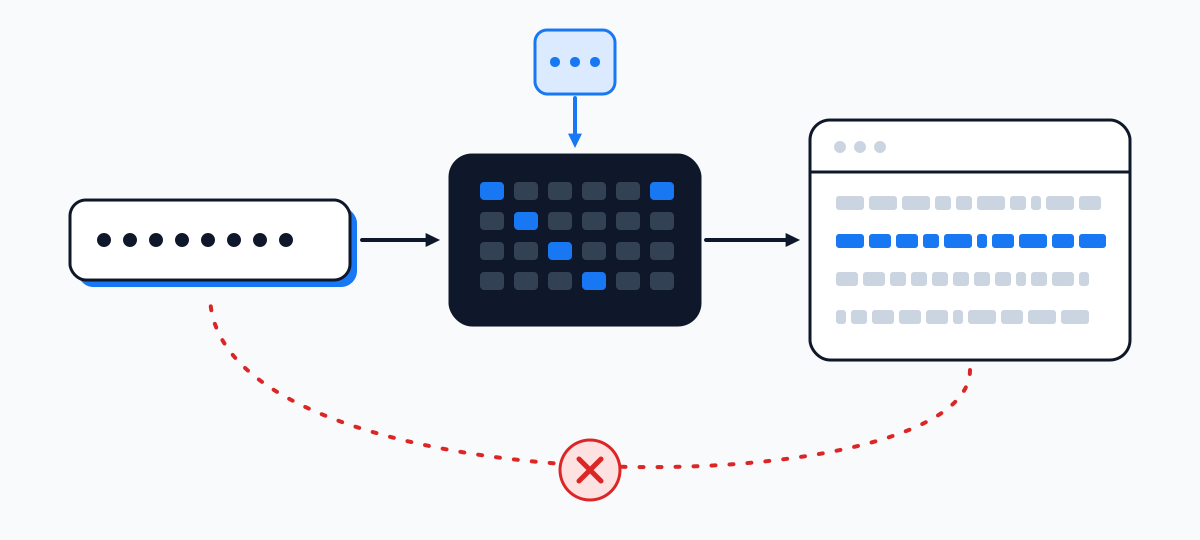
A password cracker is a program that guesses. It takes a hash — the one-way form in which a service stores a password — and tries candidates until one produces the same hash. NIST's 2025 guideline is written with this in mind: it requires passwords to be salted and hashed in a form that resists offline attack.
Two things follow. First, the cracker needs the hash, and a hash comes out of a breach of the service's own database, not out of a username typed into a web page. Second, guessing at the login screen is a different matter: NIST requires services to limit failed login attempts.
What gets tried first is not random. NIST's appendix on password strength says that passwords which are too short yield to brute-force and dictionary attacks, and that people respond to composition rules in very predictable ways. It also has services check every new password against ones already seen in breaches — the obvious first candidates.
So the accurate version of “password cracker” is this: a threat to short and reused passwords after a breach, and no use to someone who holds only a username. You can see where your own password stands: the password strength check estimates the guessing, and the password leak check looks for it in breach data.
How it really happens
How passwords are really hacked: leaks, phishing and reuse
None of the tools above takes part in any of these. Each route starts with the account's owner or with another site, and each has a point where the owner can stop it.
- 1
A breach somewhere else
A site you once signed up to loses its users' emails and passwords. TikTok's help describes what follows: credentials leaked from unrelated breaches are tried across different platforms. Google's 2019 research with NYU and UC San Diego found that most hijacking attempts on Google accounts came from automated bots holding third-party breach data.
Where the owner stops it One password per account, and a second factor: in that Google study an SMS code to a recovery phone stopped every automated bot attempt. Look an old password up in the password leak check.
- 2
A fake login page
A message with a deadline leads to a copy of the login screen. CISA lists the usual signs: urgency and threats, requests for personal data, shortened links, addresses that are slightly wrong. Instagram adds that such messages often threaten to block or delete the account.
Where the owner stops it Open the app yourself instead of the link; Instagram never raises account security in Direct. How to tell the page apart: fake login pages.
- 3
An app or “tool” that asks you to log in
Everything in the table above. Instagram says third-party services that show their own login are not affiliated with or endorsed by it, and that a login handed over gives “complete access to your account”. The person who went looking for a hack tool is the one whose login gets collected.
Where the owner stops it Type the password only into the official app or site.
- 4
An information stealer on the device
The 2025 FBI and CISA advisory on one stealer, LummaC2, names its delivery routes: fake CAPTCHA pages that tell you to paste a command, phishing links and attachments, and fake copies of popular programs. Once running, it collects credentials, crypto wallets, browser extension data and MFA data.
Where the owner stops it Never run a command a web page asks you to paste, and treat a “free” copy of a paid program as the delivery route it often is.
- 5
A short or patterned password
Guessed from a stolen hash, or simply taken from a list of common ones. That is why NIST makes services check new passwords against common and previously breached ones, and limit failed login attempts.
Where the owner stops it Length: NIST's minimum is 15 characters where the password is the only factor; CISA advises 16 or more. Estimate yours in the password strength check.
The Google figures are about Google accounts, and the LummaC2 advisory covers a single stealer and is addressed to organisations. Neither is a study of Instagram; what they show is the direction — the password leaves through its owner or through another site.
Signs
Was this “hack tool” after your own account? Six signs, weighed
Tick what the site or app asked of you. The result is a priority for what to do — not a verdict.
If you used one
Installed a hack apk, pasted a command or logged in to a tool? Six steps
- 1
Change the password you gave the tool — in the official app
The tool keeps whatever you typed into it, so that password goes first. On Instagram an updated password signs out every other device. Used it anywhere else? Replace it there as well.
You should see: your other phones and computers ask you to sign in again.
- 2
Uninstall the apk and cut its access
Delete the app itself, then revoke any third-party app you do not recognise in the account's settings — Instagram lists this among its steps for a profile that starts posting on its own.
- 3
Let Play Protect scan the phone
On Android, Google says Play Protect checks the device for potentially harmful apps from other sources and may deactivate or remove them. Google recommends leaving the scan on.
- Google Play Store
- profile icon
- Play Protect
- Settings
- Scan apps with Play Protect
- 4
Pasted a command or ran a “free” program? Treat the whole device as read
A stealer of the LummaC2 kind takes credentials and browser data, not a single password. From another, clean device, change the passwords that matter most, starting with your email.
- 5
Sign out strangers and add a second factor
Remove devices you do not recognise, then turn on two-factor authentication — Instagram calls it the single most effective step against hackers. Menus for each platform: two-factor authentication; reading the device list: Instagram login activity.
- 6
Gave the tool a code or money?
A code passed to a “specialist” is what lets a stolen password through: go through the steps for a typed password on fake login pages. Money taken in India is a matter for 1930 and cybercrime.gov.in (what they do). Already locked out of Instagram: routes back.
Questions
Password hack tools: short answers
Does an Instagram password hack apk work?
Not in the sense advertised. An app on a phone cannot read passwords from Instagram, which keeps none in readable form. The apps of this kind that were documented collected the login of the person who installed them.
What is hacking panel v2 or Instagram hacking panel v3?
A name used by sites that promise an account's password by username. We found no published examination of one, so we do not describe how a particular panel behaves. A version number does not change what the platform stores: a one-way hash.
Is Hacker Typer real hacking?
No. Whatever keys you press, movie-style code scrolls by. It is a site made for fun, and its author asks people not to send hacking requests.
Can a password cracker open an Instagram account?
A cracker guesses against a stolen hash. Without a breach of the platform's own database there is no hash, and the login page limits failed attempts. Accounts are lost to reused passwords and fake login pages instead.
I only entered someone else's username. Did the tool get anything from me?
A username is public and gives a tool nothing. The loss begins at the next step: a survey with your data, a download, a payment, or your own login. If you stopped before that, close the page.
Is there a safe password hack tool for my own account?
For your own account you do not need one. A forgotten password is replaced through the platform's reset, not revealed. What you can check yourself is on this site: whether a password is in breach data, and how long it would resist guessing.
Take it with you
Save this page as your own plan
Print the page or save it as a PDF to keep the steps next to your phone while you go through the settings. Your checklist ticks are included.
- The printout opens every route and every answer on this page in full
- The file is made by your own browser — nothing is uploaded
- This site does not log in to anyone's account and asks for no username